Case Definition View
 Case Definition View
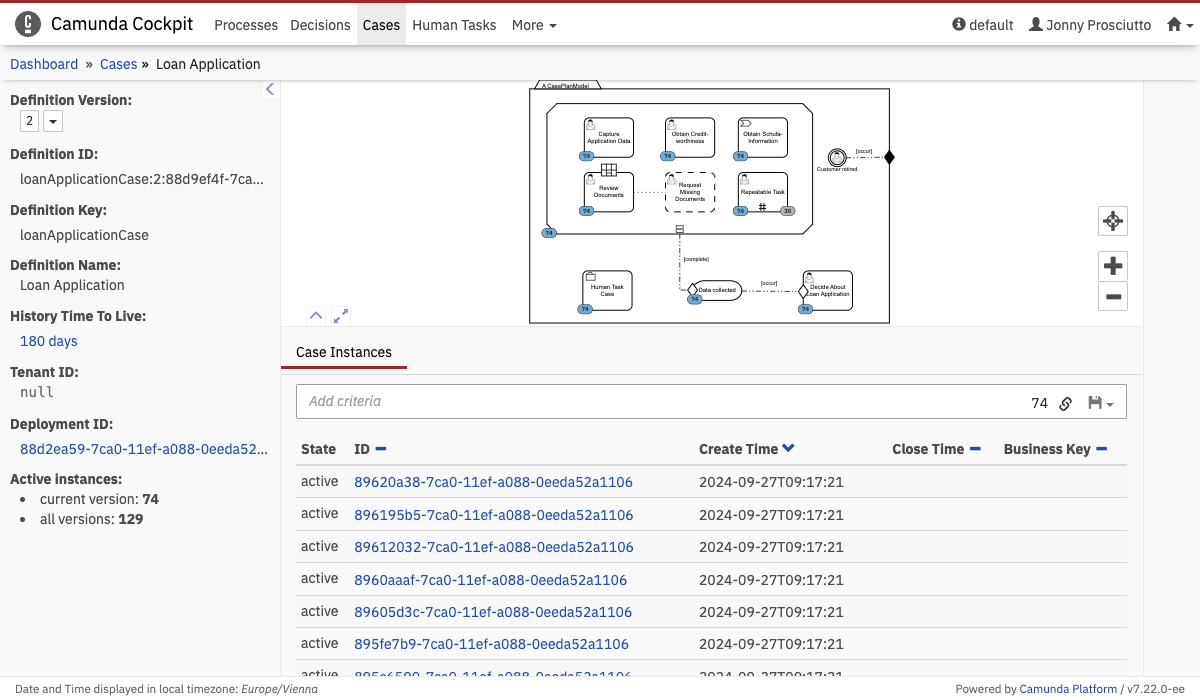
On the case definition view, you can find a diagram of the deployed case definition. Use the mouse to navigate through the diagram. Turn the mouse wheel to zoom in and out. Hold the left mouse button to pan the diagram in the desired direction.
The case definition view also provides information about the definition and the status of a case. On the left side, you can easily survey the versions of the case and how many instances of the versions are active. The version of the case definition can be changed in the drop-down menu. The diagram is then updated accordingly. Click the deployment ID to go to the deployment view.
Below the case diagram, you find a list of all instances for this definition. Besides information about creation time, close time, business key, and state, you can select an instance by ID and open the case instance view. You can also search for case instances that match certain search criteria. To do so, click in the search box and select the parameters to search for. You can also begin typing to find the required parameter faster. Depending on the selected property, you have to specify the value of the property. Some properties also allow operators other than equals, e.g., like, which lets you search for case instances where the entered value is a substring of the property value. To search for case variables, you also have to enter the variable name you want to search for. To search for a variable of type string, which has a numeric, boolean, or null value, you have to wrap the value in single quotes (e.g., '93288' or 'NULL').
Furthermore, you can copy a link to the current search query to your clipboard by clicking the button and you can save search queries to your local browser storage by clicking the button and entering a name in the drop-down menu that appears. You can then retrieve the search query by clicking the button and selecting the chosen name in the drop-down menu.
You can maximize the diagram view or the detailed information panel by clicking the button or the button at the bottom left of the diagram view.